Belen Fernandez
Voltairenet
26th July, 2009
See also:
Timeline: Israeli Embassy and Amia bombings 1992- 2006
ITNT Archive: Israeli Embassy and AMIA Bombings
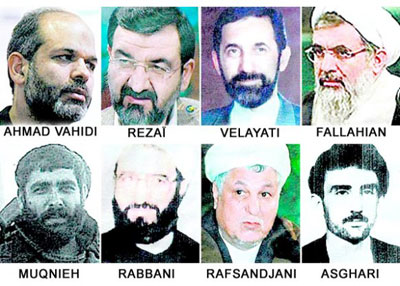
The Western campaign to demonize Iran as a state sponsor of terrorism is largely rooted in the bombing of the Jewish Center (AMIA) in Buenos Aires on July 18, 1994. Tel-Aviv and Washington immediately blamed Iran and Hezbollah, despite the fact that the attack had the fingerprints of a false-flag operation [*] all over it. Fifteen years later, the AMIA bombing continues to serve as a launching pad for an even more vicious smear and fear campaign against Iran, pandering in particular to Israel’s interests, including those in Latin America. Significantly absent from this present-day scenario is the US – undoubtedly embarrassed now that Rafsanjani, one of AMIA’s prime “suspects”, has joined the Western-sponsored opposition movement to undermine Ahmadinejad.
Walking down Avenida Figueroa Alcorta in Buenos Aires the other day, I came across a succession of posters advertising la penetración iraní en América latina [Iranian penetration in Latin America] and featuring Hugo Chávez and Mahmoud Ahmadinejad clasping hands. When I then came across the Iranian embassy and a monument in a park labeled “Plaza Irán,” as well, I became momentarily convinced that the posters might have a point.
Some confusion arose from the date on the monument, May 12, 1965, which placed its origins in an archaeological period of penetración estadounidense in Iran [U.S. penetration in Iran]. Things slowly began to make more sense, however, as I continued walking and noted that the Chávez-Ahmadinejad posters were interspersed with posters featuring an unoccupied bed with white sheets and the proclamation: 85 ‘HASTA LUEGO’ CONVERTIDOS EN ‘HASTA SIEMPRE [85 goodbyes to be remembered forever], which I first assumed was a tribute to Argentine swine flu fatalities.

It turned out that the 85 Hasta luego were in fact the victims of the 1994 attack on the AMIA, the Jewish cultural center in Buenos Aires, which was blamed with intermittent force on Iran in accordance with the current geostrategic interests of the United States. The fifteenth anniversary of the attack was to be commemorated on Friday, July 17, one day prior to the actual anniversary; passersby were invited to pursue further information at www.85vidasmenos.amia.org.ar, in which the 85 vidas menos translates as “85 fewer lives.” Not explained on the posters was whether their designer could not think of a more suitable image to commemorate bombing victims, whether viewers were meant to infer that their own beds could be penetrated at any moment by Iranians, or why there were no commemorative websites for recent events in Gaza, such as “1300vidasmenos”.
I returned home to find that my own bed was still unmade, although it was presumably not the fault of terrorists, and that the AMIA link consisted of a black page with suggestions in white as to the variety of sentiments that might have been expressed by companions of the 85 victims had they known the 85 would never be seen again. Suggestions include “I love you,” “I hate you,” and “You have a nice smile.” To one side of the written suggestions is a YouTube video with additional suggestions of hypothetical situations tragically thwarted by the bombing, such as un beso apasionado que nunca llegó [a passionate kiss that never took place], juxtaposed with the sound of attack. The question is raised of whether this sort of commemoration would not have been more appropriate in the context of the assassination of former Lebanese Prime Minister Rafik Hariri [1] which occurred on Valentine’s Day.
The AMIA website offers another less artistic page devoted to the anniversary, which explains that, given the present situación sanitaria in Argentina and the discouragement of congregations of human beings, a large physical reunion at the AMIA building on Friday is being postponed in respect of el valor supremo del cuidado de la vida [the supreme value of human life]. The contrasting lack of value placed on life by Iranians is underscored once again by the fact that they continue to visit Latin America with no regard for the swine flu epidemic.
Iranian visits are tracked in the July 2 article in Veintitrés Internacional magazine that corresponds to the Chávez-Ahmadinejad posters on Avenida Figueroa Alcorta. The article begins with an observation attributed to the Miami Herald, according to which Ahmadinejad must love the tropics based on the fact that he has spent more time in Latin America than George Bush. Not established in the article is when the ex-US president became the standard against which travel frequency to places other than Crawford, Texas, should be measured; also not established is that the observation about Ahmadinejad actually hails from a Miami Herald column of September 2007 by Andrés Oppenheimer. The column’s publication date might explain Oppenheimer’s failure to address the fact that there were no Iranian officials present at the June 2009 meeting of the Organization of American States, which was nonetheless attended by Israeli Deputy Foreign Minister Danny Ayalon.
During his Latin American jaunt, Ayalon had regurgitated Oppenheimer’s warning about the possibility of air travel between Venezuela and Iran (AYALON: “We know that there are flights from Caracas via Damascus to Tehran”). He also regurgitated the fact that Iranian agents blew up the AMIA, although he got the year wrong, and neglected Oppenheimer’s alert regarding the opening of an Iranian embassy in Bolivia and the stationing of “about 20 Iranian officials” at the embassy in Nicaragua [2]. On the other hand—a certain Ely Karmon, who is unsurprisingly Investigador Académico Senior en el Instituto Internacional de Contraterrorismo (ICT) y en el Instituto de Política y Estrategia (IPS) del Centro Interdisciplinario (IDC) in Herzliya, Israel—proves more adept at the art of regurgitation, partly because his senior academic investigatory techniques include plagiarism.
It became clear in the fourth paragraph of Karmon’s lengthy piece, before he had even begun reiterating the existence of the Caracas-Tehran flight, that my sense of déjà-vu was an effect of the fact that Karmon had almost exactly replicated an entire section of Oppenheimer’s column. Compare Oppenheimer’s English version with Karmon’s Spanish:
What is Ahmadinejad looking for in Latin America?
First, he is seeking Latin American support to counter U.S. and European pressures to stop Iran from developing nuclear capabilities. Venezuela and Cuba were, alongside Syria, the only three countries that supported Iran’s nuclear program in a February 2006 vote at the United Nations’ International Atomic Energy Agency.
Second, Ahmadinejad wants to strike back at the United States in its own hemisphere. Iran may want to be able to finance anti-American groups and possibly destabilize U.S.-friendly governments in order to negotiate with Washington from a position of greater strength. Following the U.S. invasion of Iraq, Iran seems to be saying: ‘You got into my neighborhood; now I’m getting into yours.’
Third, Ahmadinejad’s popularity at home is falling, and he may want to show his people that he is being welcomed as a hero abroad.
VS.
¿Qué busca Ahmadinejad en América Latina?
En primer lugar, busca el apoyo de América latina para contrarrestar las presiones de Estados Unidos y Europa y evitar que Irán desarrolle capacidades nucleares. Venezuela y Cuba fueron, junto con Siria, los tres únicos países que apoyaron el programa nuclear iraní en la votación de febrero de 2006 en la Agencia Internacional de Energía Atómica de Naciones Unidas.
En segundo lugar, Ahmadinejad quiere contraatacar a Estados Unidos en su propio hemisferio y, tal vez, desestabilizar a los gobiernos amigos de Estados Unidos a fin de negociar, con Washington, desde una posición de mayor fortaleza.
En tercer lugar, la popularidad en su propio país de Ahmadinejad está cayendo y quiere mostrar a su pueblo que, en el exterior, es recibido como un héroe.
The only perceptible alteration of the text is Karmon’s exclusion of the sentence: “Following the U.S. invasion of Iraq, Iran seems to be saying: ‘You got into my neighborhood; now I’m getting into yours.’” The exclusion prevents readers from wrongly assuming that the practice of neighborhood penetration was not invented by the Islamic Republic.
Karmon proceeds to explore indicators of penetration such as that Farsi is now being taught at Venezuelan universities while a number of Iranian engineers have learned basic Spanish. The late Italian journalist Oriana Fallaci had also expressed dismay at curricular evolution, and at the fact that people named Mustafa or Muhammed were permitted to study chemistry and biology at US universities despite the threat of biochemical war. Fallaci’s proposed blueprint for counteracting the Islamic penetration of Europe was meanwhile to explode mosques on Italian territory; as for destruction wrought by less frequent Latin American visitors than Ahmadinejad, the White House archives provide a transcript of George Bush’s speech at a Miami celebration of Cuban Independence Day in 2002, the introduction to which was as follows:
The President: Thank you very much. Siéntese. Voy a hablar en Espanol hoy — (applause) — pero no. No. (Laughter.) No quiero destruir un idioma que bonita, y por eso voy a hablar en Inglés. [I don’t want to destroy a beautiful language so I’m going to speak in English.] (Laughter)
Bush would prove the following year that his concern for the preservation of Iraq was inferior to his concern for the preservation of the Spanish language, which was nonetheless called into question later in his speech when he translated “the entire world” as “the todos.” He did, however, accurately translate his secretary of state as “señorita Arroz”; the concern of White House transcribers for the English language was in the meantime evident via Bush’s transcribed proclamation that I can’t — listen, every time I see and here Gloria Estefan sing, it makes my heart feel better.
Further curious linguistic arrangements occurred during Bush’s glorification of Emilio, a Cuban-American college student who assisted mentally challenged Cuban-American children in addition to cleaning parks:
The reason I bring up Emilio is I say oftentimes to Americans who want to — how best they can participate in our country, how best to fight evil is to do some good; is to love a neighbor like you’d like to be loved yourself. If you’re interested, if you’re interested in helping define our nation to the world, and if you’re interested in resisting evil, do some good. And that’s what Emilio does.
Ely Karmon continues to manage the fight against evil in other arenas, contributing evidence of the Iranian origins of the attack on the AMIA and of Iranian-Venezuelan collaboration in the production of tractors. He at times speaks about Néstor Kirchner as though he is the current president of Argentina, with confusion possibly stemming from the fact that Karmon’s notes are from the Oppenheimer column of 2007 and that [Argentinian President] Cristina Fernández presumably collaborates with her husband.
As for confusion surrounding the AMIA bombing, one example is that only one out of 200 witnesses to the attack saw a white Renault van, the purchase of which Argentine intelligence attempted to pin on an Iranian cultural attaché who had then supposedly allowed it to be filled with explosives. The predilection for white vans in US efforts to isolate undesirable regimes had also been observed in the UN investigation of the Hariri assassination [3], which involved a white Mitsubishi van and a primary witness who was a convicted criminal.
Oppenheimer informs us that the growing presence of obscure Iranian ‘diplomatic personnel’ in Venezuela, Nicaragua and other countries in the region raises questions over whether Iranian agents will soon start slipping into other countries to support terrorist or totalitarian groups. Karmon updates the threat of slippage with the information that Evo Morales has ceased requiring visas from Iranian travelers to Bolivia and that a US intelligence official has revealed in the Los Angeles Times that Hezbollah and the Iranian Revolutionary Guard Corps have decided to capture Jews in South America and smuggle them to Lebanon. Capture is supposedly being facilitated by Venezuelan airport workers who provide information on Jewish travelers; the ease of intercontinental slippage is confirmed by the LA Times article, which reminds us that there are weekly IranAir flights from Tehran to Caracas.
After dabbling in plagiarism of the LA Times, Karmon rambles on through the possibility that Hassan Nasrallah might decide, based on la inmunidad práctica del pasado [the impunity of the past], that Latin American terrain might be used to exact revenge for the assassination of Imad Mughniyeh. Karmon fails to address other past instances of practical immunity such as the assassination of Imad Mughniyeh, and adds to the credibility of Hezbollah’s designs by referencing recently thwarted vengeful attempts in Azerbaijan and un país europeo no identificado [an unidentified European country].

- AMIA wanted list: including Muqnieh/Mughniyeh (see above) and Rafsanjani who is presently aligned with the Western-sponsored opposition to President Ahmadinejad.
Karmon reviews the dangers posed by the exportación de la enseñanza ideológica chiita radical y religiosa [the export of religious radical shia ideological teachings] and its potential influence on the social structure of Latin America, which will certainly be more difficult to maintain when the barrios of Caracas convert to Shiism. The article concludes with the question of what will happen if Iran, at the request of Chávez, decides to deploy long-range missiles in Venezuela; no mention is made of what sort of range Israeli weapons have.
Ely Karmon’s article in Veintitrés Internacional complies with AMIA’s stipulation that the fifteenth anniversary of the bombing be commemorated with minimal physical congregation of prospective swine flu transmitters. We are left to wonder why Karmon does not take it upon himself to extend his campaign against Iran to discredit the president of Honduras, as well, by exposing flight options from Tegucigalpa to Tehran via London—which are of course only feasible when the Honduran airport is open.
[*] False flag operations are covert operations conducted by governments, corporations, or other organizations, which are designed to deceive the public in such a way that the operations appear as though they are being carried out by other entities. The name is derived from the military concept of flying false colors; that is, flying the flag of a country other than one’s own. False flag operations are not limited to war and counter-insurgency operations, and have been used in peace-time; for example, during Italy’s strategy of tension.
 In These New Times