Thierry Meyssan
Voltairenet
1st February, 2011
The mainstream media are enthralled by the demonstrations in Egypt and are heralding the advent of a Western-style democracy throughout the Middle East. Thierry Meyssan refutes this interpretation. According to him, antagonistic forces have been set in motion, the outcome of which will turn against the order imposed by the United States in the region.
For the past week, western media have echoed reports about the demonstrations and repression rattling major Egyptian cities. They draw a parallel with the events that brought down Zine el-Abidine Ben Ali in Tunisia and speak about a wind of revolt that is sweeping the Arab world. According to them, the movement could stretch to Libya and Syria. They further speculate that it should favour secular democratic sectors rather than Islamic forces since the influence of the clergy has been overestimated by the Bush administration and the “mollah regime” of Iran acts as a deterrent. Thus, the wish expressed by Barack Obama at Cairo University will be fulfilled: democracy will reign in the Middle East.
This analysis is erroneous in all respects.
 In the first place, the demonstrations in Egypt started several months ago. Western media ignored them, thinking they were short-lived. The Egyptians were not infected by the Tunisians, but the latter opened the eyes of the Western world to what was happening in that region.
Secondly, the Tunisian people rose up against a corrupt government and administration that progressively brought all of society to its knees, stripping the ever expanding social classes of all hope. The Egyptian revolt is not aimed against this mode of exploitation, but against a government and administration that are so engrossed in serving the interests of foreign powers that they have no energy left to tend to the basic needs of the population.
In recent years, Egypt has been rocked by numerous riots, either in protest against the Egyptian Government’s collaboration with Zionism or fueled by hunger. These two factors are closely intertwined. The protestors raise pell-mell issues such as the Camp David accords, the Gaza siege, Egypt’s Nile water rights, the partition of Sudan, the housing crisis, unemployment, injustice and poverty.
Moreover, Tunisia was administered by a police regime, whereas Egypt is under the military boot. I use the term “administered” – and not “governed”- since in both cases, we are dealing with States under post-colonial tutelage, which lack both a foreign policy and an independent defense. Consequently, while in Tunisia the army came between the population and the dictator’s police forces, in Egypt the problem will be settled through a shootout among the military.
Thirdly, what is occurring in Tunisia and Egypt is unquestionably a sign of hope for all oppressed peoples; however, these are not the same people that the media have in mind. For the journalists, the villains are those governments that challenge – or pretend to challenge – Western policies. But for the people, the tyrants are those who exploit and humiliate them. For this reason, I don’t believe that we will be seeing similar revolts explode in Syria. The Syrians are proud of the Bachar el-Assad government: he sided with the Resistance and managed to safeguard his national interests without ever capitulating to pressure. Most of all, he was able to shield his country from the fate contrived by Washington: either chaos like Iraq or Saudi-style religious despotism. Admittedly, many features of his management style are contested, but he is developing a middle class together with the democratic decision-making processes that underpin it. By contrast, such countries like Jordan and Yemen are breeding grounds for instability and the contagion could also hit Black Africa, Senegal in particular.
Fourthly, western media are discovering rather late that the Islamic threat is merely a scarecrow. But it is still necessary to acknowledge that it was activated by the United States under the Clinton administration and by France in Algeria during the 1990’s with François Mitterand at the helm, then blown up by the Bush administration in the aftermath of the September 11 attacks, and fueled by the European neo-conservative governments of Blair, Merkel and Sarkozy. It would also time to recognise that there is no common measure between Saudi Wahhabism and the Islamic Revolution of Rouhollah Khomeini. Labeling both as “Islamists” is not only absurd, it is also an obstinate refusal to understand what is really happening.
In collusion with the United States, the Saudis funded sectarian Muslim groups that preached for a resurgence of Seventh-century society as they dreamed of it during the era of Prophet Muhammad. They have just as much impact in the Arab World as the Amish in the United States, with their horse and buggy.
The aim of the Khomeiny Revolution is not to erect the ideal religious society, but to reverse the system of world dominance. It predicates that political action is a means of self-sacrifice and self-transcendence and that, consequently, man can draw from Islam the necessary energy for change.
The Middle East populations have no intention of replacing the police and military dictatorships that have crushed them with a religious dictatorship. So, there is no Islamic danger. At the same time, the Islamic revolutionary ideal that has already given rise to the Hezbollah in the Lebanese Shia community is also animating the Hamas amid the Sunni community in Palestine. This element is likely to play a role in the bourgeoning mouvements and, indeed, is already playing one in Egypt.
Fifthly, with all due respect to certain observers, even if social issues are again in the forefront, the ongoing movement cannot be reduced to simply a matter of class struggle. Obviously the ruling classes fear popular revolutions, but things are more complicated. Hence, not surprisingly, King Abdallah of Saudi Arabia called on President Obama to stop the mayhem in Egypt and to protect incumbent governments in the region, starting with his own. However, the same King has also recently endorsed the democratic change of regime that took place in Lebanon. He turned his back on Lebanese-Saudi billionaire Saad Hariri and helped the 8-March coalition, comprising Hezbollah, replace him with Lebanese-Saudi billionnaire, Najib Mikati. Hariri had been elected by parliamentarians that represented 45% of the electorate, while Mikati’s win was secured by a group representing 70% of the voters. Hariri cowered to Paris and Washington; Mikati has pledged to enact a policy favouring the national Resistance. At the present juncture, the struggle against the Zionist project overrides the question of class interests. Moreover, more than wealth distribution, the protesters are challenging the pseudo-liberal capitalist system imposed by the Zionists.
Sixtly, reverting to the situation in Egypt, Western media threw themselves at Mohamed ElBaradei, hailing him as the leader of the opposition. That’s laughable! Mr. ElBaradei enjoys a respectable reputation in Europe for having held out against the Bush administration for some time, without ever completely opposing it. He incarnates the good conscience of Europe with respect to Iraq, considering its flip-flop stance over the war. Objectively, however, Mr. ElBaradei is a luke-warm personality who was awarded the Nobel Peace Prize only to keep Hans Blix from getting it. Most important, he doesn’t carry any weight inside his own country. His only political existence is limited to his role as spokesperson of the Muslim Brotherhood in front of the Western media.
The United States has come up with opponents who are more representative, such as Ayman Nour, whom they will soon pull out of a hat, despite the fact that his defense of pseudo-liberal economic policies disqualifies him in light of the crisis that is ripping the country.
In any event, there are only two mass organisations with any real popular roots, which have for a long time spoken out against the current policies: on the one hand, the Muslim Brotherhood and, on the other, the Coptic Christian Church (even though H.H. Pope Shenouda III distinguishes between Mubarak’s Zionist policies which he opposes and the Rais figure that he accepts to deal with). This detail escaped the Western media which were too busy persuading public opinion that the Copts were being persecuted at the hands of the Muslims while they were, in fact, being victimised by the Mubarak dictatorship.
A small digression is required at this point: Hosni Mubarak has just named Omar Suleiman vice-president. It is a measure aimed at rendering more difficult his eventual physical ousting by the United States. Mubarak became president because he had been designated vice-president before the United States had president Anwar El Sadat taken out by Ayman al-Zawahiri’s group. Consequently, he has until now always refused to appoint a vice-president for fear of being assassinated in turn. In Omar Suleiman he chose one of his accomplices, who also has Sadat’s blood on his hands. Henceforth, to take over power, it will not be enough to kill the president, the vice-president will have to be eliminated as well. Omar Suleiman being the chief architect of Egypt’s collaboration with Israel, Washington and London will protect him like the apple of their eye.
What is more, Suleiman can lean on Tsahal against the White House. He has already arranged for the arrival of Israeli material and snipers, ready to kill the ringleaders among the crowd.

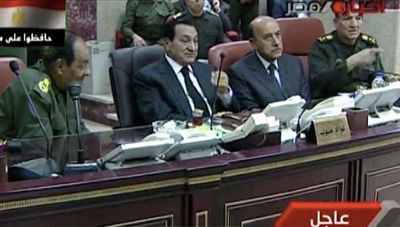
- General-President Hosni Mubarak and General-Vice-President Omar Suleiman appeared on television flanked by their military advisers to signify that the army is in power and will remain in power.
Lastly, the current situation lays bare the contradictions within the U.S. administration. In his Cairo University speech, Barack Obama had offered to extend a hand to Muslims and had called for democracy. Today, however, he will make every effort to prevent democratic elections in Egypt from taking place. If he can put up with a legitimate government in Tunisia, he cannot do the same in Egypt. Elections would play out in favour of the Muslim Brotherhood and the Copts, who would form a government that would open the Gaza border and liberate the millions of people who are locked inside. With the support of their neighbours – Lebanon, Syria and Egypt – the Palestinians would overthrow the Zionist yoke.
It should be noted that over the last two years, Israeli strategists have been concocting a foul trick. Considering that Egypt is a social time bomb, that revolution is both inevitable and imminent, they planned to facilitate a coup d’Etat in favour of an ambitious and incompetent officer. In their scheme, the latter was supposed to launch an abortive war against Israel. Tel-Aviv would thus have recovered its military prestige and reconquered Mount Sinai with its natural riches. But Washington is resolutely against this scenario, which would be too difficult to control.
Ultimately, the Anglo-American Empire is still anchored to the principles laid down in 1945: to support those democracies that make the “right choice” (that of servility) and to oppose the nations that make the “wrong choice” (that of independence).
Consequently, if they deem it necessary, Washington and London will endorse without any qualms a bloodbath in Egypt, provided that the military who wins the upper hand pledges to maintain the international status quo.
 In These New Times