Detroit: Coming In On A Wing and A Prayer
Posted by smeddum on November 28, 2008
Detroit: Coming In On A Wing and A Prayer
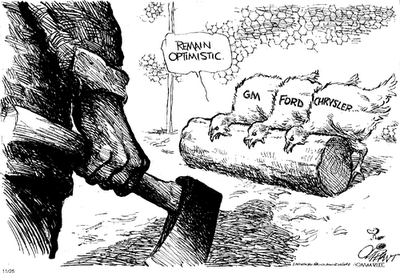
Jerry Flint, 11.27.08, Forbes.com
As bad as this year has been for the auto industry, next year could be worse–perhaps much worse.
The collapse in sales is at the crux of the problem. For over a decade, U.S. auto sales have been running from 16.5 million to over 17 million cars and light trucks per year. Last year they fell to 16.2 million. This year–thanks to the collapse in the second half of the year–full-year sales could fall to 13.5 million.
For 2009, General Motors executives talk about the possibility of annual sales falling to 11.7 million vehicles; Standard & Poor’s estimates 12.8 million. If either of these forecasts is correct, it will be a nightmare, and not just for Detroit.
Even Toyota Motor is losing money in the U.S. and is curbing production. Honda Motor, too, just announced U.S. production cutbacks. Toyota is one of the financially strongest automakers, so this slowdown is likely to be harder on the smaller Asian auto companies such as Mitsubishi Motors.
The Japanese yen is now trading near its fair value–96 to the dollar at last check–and the Japanese like to see it at 115. While the Japanese companies build most of their U.S. market vehicles here, maybe 25% of their cost is still in Japan.
The Germans are also hurting, but not as much. So far, the volume drops are not as great at BMW (down 10% for the year), Mercedes (down 5%) and VW plus Audi (down 2%). The dollar has risen 20% against the euro, which also helps these manufacturers.
Suppose that Washington comes through with a bailout for the domestic manufacturers. With such help, GM will survive this year. With an infusion of billions of dollars, it should survive next year, too. GM will not have to go back to the government for more money. Meanwhile, all of the bailout and bankruptcy talk is scaring away customers. This means that GM’s market share, which was 23.7% last year, could fall to less than 20%, perhaps as low as 18% or 16%, putting GM close to Toyota in market size.
GM has a plus side: New vehicles are coming, and if they live up to the promises made by GM executives, they could help save the company. The upcoming Chevrolet Cruze subcompact looks good and is supposed to get 40 miles per gallon on the highway. The Cruze is not due until 2010, but with financial help from Washington, GM should get it out on time or perhaps a few weeks ahead of schedule. Aid from the government could also help GM with the funds needed to expand the Cruze model range.
Let’s not forget the sporty Chevrolet Camaro, due next spring, CTS derivatives from Cadillac and a new Buick sedan that GM also has in the works. GM’s big gamble, of course, is the Chevrolet Volt, a plug-in hybrid, which it hopes to launch at the end of 2010. If it really works, it will stir the crowds.
Ford Motor will hold its market share at 15%, maybe 16%, and move ahead. The company has a flock of new products on tap. That ambitious list includes the new Fiesta small car, the improved Focus, the hybrid Fusion and fuel-efficient twin turbo engines for several Ford models. Ford also has modest updates coming of crucial vehicles, such as the Mustang. Most of these models are due in 2010 or later, but Ford can get by next year without federal money.
Chrysler is more complicated. Federal money could keep it going, but its owner, Cerberus Capital Management, still wants to sell the company. My best guess is that Cerberus will bail out next year and that Carlos Ghosn and Renault/Nissan will be the buyer.
With any luck, the first $25 billion in aid from Washington will be enough until the market begins returning in late summer of next year and the new models start appearing. That is an optimistic view.
Among the foreigners, Honda Motor will do the best, with the new hybrid Insight winning customers and no big pickups burdening the lineup. Next year will not be easy for Toyota, but the Germans will do better, because even in recession, all that bailout money to banks and Wall Street means demand for BMWs, Mercedes and Audis. Luxury car makers love our Mr. Paulson.
OK, what if Congress does not provide aid or puts so many restrictions on the money that the auto companies cannot cash the check?
Here we go entirely to speculation.
I think GM would escape bankruptcy, but end up at half its present size, or even smaller. The surviving parts would include Chevrolet–building some cars, plus the profitable pickups and SUVs–and GMC. Cadillac and Saturn might survive, but Buick, Pontiac and Hummer could step off the stage. The plant closings would be heavy, and the Midwest states would be devastated. Cutbacks of this magnitude would worsen the national recession and increase the costs of unemployment compensation and Medicaid.
My estimate is that it will cost more for the stricken states to keep schools open and essential services running than the money that Detroit was asking from Washington.
Whatever happens in the U.S.–even in a worst-case scenario–GM’s overseas empire in Europe, Brazil and China would endure. Toyota would become the nation’s No. 1 car seller. The senator from Alabama, who helped block any aid, will be smirking as Alabama’s foreign car plants step up production.
Ford Motor can survive next year without the federal money and will enhance its reputation for toughness. If GM collapses, Ford’s market share will grow. Either way, Ford could have a great year in 2010.
Chrysler? With the right leadership, Chrysler could survive and grow, but Lee Iacocca is not there anymore. My guess is that a company such as Nissan/Renault will buy the most promising parts of Chrysler, such as Jeep, the Canadian minivan plant and one pickup truck plant. Those vehicles and some rebadged Nissans will keep some Chrysler dealers alive. Many more Chrysler workers, however, would lose their jobs.
All we can hope is that the government comes through with aid and that there is a sharp rebound in sales. The sooner we see a sales recovery, the better the chances that the country will still have three Detroit automakers.
 In These New Times
smeddum said
The uncertainty is grave. The damage done by derivatives is overlooked.
John said
agree with you, smeddum