Iran is sending aid ships to blockaded Gaza, state radio said on Monday – a move likely to be considered provocative by Israel which accuses Tehran of arming the Palestinian enclave’s Islamist rulers, Hamas.
Israeli Army commander and top Likud member Uzi Dayan today warned on Israeli Army Radio that Israel would consider any attempt by the Turkish military to protect future aid ships from attack an “act of war.”
As is often the case when the stakes are high, the media distracts the public from the real issues. The handling of the Israeli attack against the Freedom Flotilla is another illustration of this. The mainstream media has been trying to distinguish between the good and the bad guys, instead of analysing what is being played out. In this article, Thierry Meyssan dissects both Tel Aviv’s and Ankara’s real motives, and discloses the «detail» that transformed Israel’s armed operation into a diplomatic debacle.
One week after the attack by Israeli forces on the high seas against a humanitarian convoy, what are the new elements that have emerged and what initial conclusions can be drawn? Before answering these questions, we should start by sweeping aside the media babble clouding the issue.
In the first place, the aim of the Freedom Flotilla was not simply to transport material assistance to the people of Gaza, but also to break the blockade [1]. This fact, which was kept secret for two days, suddenly crept into the arguments of Israeli spokespersons. Hence they accused the humanitarian workers of being crypto-political activists, notwithstanding their consistent claim that their action was meant to compensate for the failure of States to enforce international and humanitarian law. The activists aboard the Flotilla were ordinary citizens from various parts of the world determined to enact the provisions of UN resolution 1860.
The Israeli spokespersons blamed the Flotilla passengers for opposing resistance, accusing them of having used weapons against the soldiers. This was purported to show that the people were actually « terrorists ». To corroborate this story, the Foreign Ministry disseminated various photos of knives and attack weapons confiscated on the Mavi Marmara [2]. Now, it just so happens that the photos’ EXIF data indicates that most are old and were taken in a different context [3].
This is a classic propaganda technique : while we are busy discussing the authenticity of the photos, they are conveniently masking the fact that, in the eyes of international law, not only is the continuation of the blockade illegal, but, as the occupying power, Israel has the duty to ensure the safe delivery of the humanitarian aid. In addition, the attack on the flotilla in international waters being illegal, the passengers had the legitimate right to rebel, provided they – the passengers – made use of « proportionate force », which was the case.
Secondly, in terms of security, Israel had no need to stop this fleet. It was not transporting weapons for the Palestinian resistance, only aid for the population. Indeed, Tel Aviv has imposed an embargo which, in the words of the United Nations Special Rapporteur, amounts to “collective punishment”, but even under this punishment inflicted on 1.5 million Gazans, 10,000 tons of goods do not represent a significant stake. It is not with less than 7 kg per capita that the people of Gaza will rebuild their houses and feed their families. Israel has already allowed ground and sea convoys to go through and, this week, it has pledged to deliver the aid arriving on the cargo vessel Rachel Corrie.
Israel’s goal, as I have stated from the beginning, was to “undercut the credibility of Turkey », at a time when it has been moving closer to Syria and Iran – or, clearly stated, to bring down the Erdogan government and “claim the leadership of the Zionist movement by showing that Tel Aviv decides and Washington complies [4].
The respective strategies
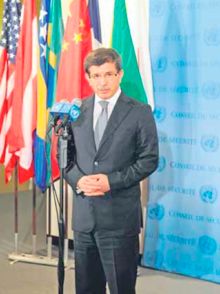
Turkish Foreign Minister Ahmet Davutoğlu giving a press conference at the end of the UN Security Council meeting.
This ninth convoy composed of a group of associations was supported by Ankara to demonstrate the illegality of the blockade.
At his press conference in New York, Turkish Foreign Minister Ahmet Davutoğlu, said his government had intensified its contacts with his Israeli counterpart to inform him about the convoy and to request free passage.
As far as we can tell, Ankara had considered three scenarios: 1. Israel gives the convoy the green light, which is greeted triumphantly by the Gazans. In this case, Turkey can demonstrate that, unlike most Arab governments, it is independent and does not abide by the orders of Tel Aviv. 2. Israel diverts the convoy and directs it the port of Ashdod/Isdud. The goods and the humanitarian workers proceed to Gaza by road, where they are given a jubilant welcome. Tel Aviv can hold its head up high, and Ankara’s political gain is minimum. 3. Israel sabotages the convoy or boards it for inspection. In this case, Ankara internationalises the incident and seizes the opportunity to challenge the continuation of the blockade. Politically speaking, this is the best scenario.
The Israeli government believed it had another option: to show to the Turkish Army Chiefs of Staff that if the civilian government came to the aid of the Palestinians, Tel Aviv could in turn instigate the Kurdish separatists; and prove once again that, with the backing of the United States, Israel is above international law. In short, the Netanyahu government considered it possible to pressure the Turkish military to organise a fifth coup d’état.
With this in mind, the Netanyahu-Barak duo sponsored Kurdish mercenaries to launch a terrorist attack against the naval military base of Iskenderun in southern Turkey. It was carried out on 31 May shortly after midnight. Rockets were fired during the changing of the guard, killing 7 soldiers [5].
Moreover, the Israeli government made sure it had Washington’s endorsement [6]. As was pointed out by Libyan leader Muammar al-Gaddafi [7], it is unthinkable that the Israeli forces could have launched a piracy operation in the Mediterranean Sea without first informing the VIth United States fleet, responsible for combating piracy and terrorism in this area and with whom they routinely collaborate. Israel’s idea was to seize the goods and forward them to Gaza to show its good faith, while arresting the activists and accuse them of having ties with the “jihadists” in order to compromise the democratic-Muslim government of the AKP (Justice and Development Party).
The storming of the flotilla could have taken place either at night in the high seas or by day in Palestinian waters. The Israeli government chose the first option so that the assault would not be commented live on satellite television networks by the sixty-odd journalists invited by the associations. The order was given once the attack against the Iskenderun naval base was over.
Israel was, in fact, well covered by the United States, which (together with France) struggled to avert any binding decision by the Security Council. After an interminable session, what finally came out was a miserly presidential statement [8]. It contains a litany of pious wishes on the liberation of prisoners, on humanitarian aid for the Gazans, and the creation of a Palestinian State.
In the wings, the Council was divided on a specific legal point, which we explain in greater detail below. It revealed its impotence to take direct responsibility for the elucidation of the facts: instead of creating an inquiry commission, it limited itself to calling for “a prompt, impartial, credible and transparent investigation [possibly by Israel] conforming to international standards ».
While, on its part, the UN Commission on Human Rights has created a fact-finding mission, the fact remains that its area of authority is limited [9] As it happens, Israel couldn’t care less, as was the case vis-à-vis Desmond Tutu’s mission on the crimes perpetrated at Jenin, and that of Richard Goldstone on the Gaza bombardments.
Territorial confusion
Although news agencies were reporting that 16 had been killed, the actual death toll would appear to be 9, provided of course the seriously wounded do not succumb to their injuries. According to Turkish television, the Israeli squad had a list of people to be eliminated, but their plan was thwarted by the resistance of the passengers; only Raed Salah, one of the leaders of the Islamic Movement in Israel, was hit. It is probable that at the time it ordered the assault, the Netanyahu government already knew that the Mavi Marmara had been registered in the Comoros Islands. The commandos therefore believed they were acting on Comoran territory.
However, the organizers, who were politically supported by the Turkish authorities, had hoisted the Turkish flag, not the one from Comoros. In addition, they had displayed a huge Turkish flag on the side of the cargo. According to the jurisprudence at the International Court of Justice in The Hague [10], the boat was not Comorian territory, but Turkish. Besides, it had already changed its nationality when it joined the rest of the fleet and was denied mooring by the Republic of Cyprus precisely for that reason.
International debate on the failure of Israeli intelligence has been focusing exclusively on this one issue: how could the Mossad not have known about the boat’s change of nationality? All the awkward statements coming from the Foreign Ministries, in Washington, Paris and elsewhere, requesting that the facts be established before they can decide on the legal consequences, reflect the same concern : at the time of the assault, was the Mavi Marmara Comoran or Turkish territory ?
The answer to that question is of the utmost importance. Indeed, Turkey is member of the NATO and article 5 of the North Atlantic Treaty stipulates that : « The Parties agree that an armed attack against one or more of them in Europe or North America shall be considered an attack against them all and consequently they agree that, if such an armed attack occurs, each of them, in exercise of the right of individual or collective self-defence recognised by Article 51 of the Charter of the United Nations, will assist the Party or Parties so attacked by taking forthwith, individually and in concert with the other Parties, such action as it deems necessary, including the use of armed force, to restore and maintain the security of the North Atlantic area.”
Just before the Atlantic Council meeting, Turkish Justice proceeded to a new crackdown to arrest people suspected of plotting against the constitutional government. Among the suspects is former Minister of Justice Seyfi Oktay. They allegedly belonged to the Ergenekon network, the current local version of Gladio, that is to say the secret services of NATO.
The symbolism of these arrests has been heightened by the campaign conducted for the last two years by the supporters of the AKP in the media. Through televised fiction and films, they have been popularizing the way in which NATO intelligence services organised four consecutive coups d’Etat in their country. They haven’t stopped explaining that the Anglo-Saxons play a double game; officially allied to Ankara, they have been stoking the Kurdish, Armenian and Cyprus problems with a view to destabilizing Turkey.
At the end of a long and trying meeting behind closed doors, NATO Secretary-General Anders Fogh Rasmussen pronounced a one-sentence declaration : “I request the immediate release of the detained civilians and ships held by Israel” [11].
Of course, no one ever considered seriously that NATO would coerce Israel, but therein lies the pressure lever : in order to preserve the Alliance, it was paramount for the United States to arrive at an amicable resolution of the conflict.
Exactly 24 hours after Rasmussen’s statement, the spokesman of the Israeli jailhouse administration announced the release of all foreign prisoners (Israeli nationals remained in detention) and their return to their countries of origin or to other host countries.
This new developmet brought an unexpected problem. The Atlantic Alliance was created by the United States and the United Kingdom together with the states belonging to their post-Yalta sphere of influence. They were the masters and the other members were under their command. Apart from the DeGaulle interlude, no member has ever dared to question this set up. Until now: as a sign of its ascending power, Turkey has just used the North Atlantic Treaty to force the hand of the United States.
The Erdoğan-Peres tête-à-tête continues
While handcuffing and beating up their prisoners, the Israeli commando squads were shouting ” One minute! “, “One minute! “, in mocking reference to the altercation between Prime Minister Recep Tayyip Erdogan and Israeli president Shimon Peres, during the 2009 Davos Economic Forum.
[Voltaire Network is not responsible for the random publicity inserted by Google in this video.]
This verbal affront has incensed Turkish public opinion who considers itself insulted through its Prime Minister. Not only does it approve of Mr. Erdogan’s reaction, it wants him to play a more assertive role on the international scene, as indicated by the lastest polls.
This explains why the Turkish Parliament adopted a very aggressive resolution, urging the Government to «reconsider … political, military and economic relations with Israel and take the most effective measures necessary.» [12]
The Ministry of Justice has constituted a working group to examine all legal recourses contemplated in domestic as well as international law. It is essentially drawing on a memorandum by a London lawyers’ association, that we have published in full. [13]
An investigation has been opened by the Prosecutor’s office in Istanbul-Bakirköy [14] which has already arranged for a forensic autopsy of the victims plus a hearing of the Turkish witnesses. It could swiftly indict Benjanmin Netanyahu and Generals Ehud Barack and Gabi Ashkenasi for piracy, aggravated assault, murder, kidnapping and arbitrary detention. _ However, according to the available evidence, the prosecutor could reclassify the charges as crimes against humanity. In that event, the accused could no longer travel abroad without risking being taken in for questioning.
Asserting the leadership of the Zionist movement
If one goes by the White House press releases and briefings relating to the successive phone conversations between president Obama and Prime Minister Natanyahu, the Israelis were initially proud of their operation. The first call was placed by Mr Netanyahu, apologizing to President Obama for being unable to honour his invitation given the events that forced him to return immediately in Tel Aviv. In the course of the second conversation, Mr. Netanyahu gave his version of the events, putting President Obama before a fait accompli. While the United States authorized the inspection of the boats, it did not anticipate the slaughter. The third conversation centered on how the Security Council meeting should be torpedoed, in other words the Israeli imposed their road map to the United States.
The tone changes when it comes to referring the matter to the Atlantic Council. Mr Netanyahu becomes difficult to reach, while Secretary of State Hillary Clinton has to confront her Turkish counterpart who came to harass her. She looks for a scapegoat and asks General Ehud Barack to find a solution by pinning the responsibility on a subordinate, but Barack refuses to go along. Not only did he not dissociate himself from the commando squad involved in the raid, but he stood up for the soldiers and even paid them a personal visit.
Ultimately, the Israelis were obliged to release the prisoners. They imposed the situation but finally the solution was imposed on them. An additional problem arises from the killing of Furkan Dogan, a young man of dual Turkish-U.S. nationality, whose family may sue the State of Israel for murder in a U.S. court.
Furkan Doğan’s funeral. The posters say “Our honour, our martyr”.
Initial conclusions
In the end, the Israeli government failed to reach its two objectives.
Turkey has come out strengthened from the confrontation, reinforcing as well the triangle it has formed with her Syrian and Iranian allies. At the same time,Turkey has acquired several new cards. Turkish Justice will judge in absentia the Israeli Ministers and generals for the crimes committed. The fact-finding mission set up by the UN Commission on Human Rights will tarnish Israel’s image even further.
Above all, Turkey is in a position to play a second game. According to our information, Ankara. According to our information, Ankara has told the State Department that Mr Erdogan was planning to personally break the blockade of Gaza, as François Mitterrand did with the siege of Sarajevo [15]. He could embark on a fleet chartered by humanitarian associations and politically supported by governments, including Iran, Syria and Venezuela. Hassan Nasrallah, Hezbollah Secretary General, has already called on all the Lebanese to take part in future initiatives. A appeal could also be made to sailors in the Mediterranean Sea, so that hundreds of pleasure boats could join in. The whole operation would be escorted by the Turkish navy, a member of NATO.
This prospect has alarmed Washington which more enthusiastically than ever is trying to convince Tel Aviv to lift the blockade.
Furthermore, the prestige acquired by Turkey during this operation spotlights the collaboration of certain Arab governments with Israel, particularly that of Hosni Moubarak.
The Egyptian President has indeed actively contributed to the siege of Gaza to prevent any contact between the Palestinian Hamas and the Egyptian Moslem Brothers. Cairo had no qualms about building a steel wall with money from the U.S. and French know-how to immure 1,5 million Gazans [16]. And one stills remember Foreign Secretary Ali Aboul Gheit’s reply when asked what he would do about the starving women and children who tried to cross the border: “Let them try and we will break their legs!”.
As a result, the blood of the Marmara victims has spilled on the Mubarak Government and Alexandria is on the brink of an uprising. To release the tension, the Egyptial government has decided to partially open the border temporarily.
Before playing in the big leagues, Turkey had most probably secured its rear. Based on diplomatic sources, our hypothesis is that Turkey received guarantees from Russia during President Dmitry Medvedev’s visit to the Middle East. This scenario is corroborated by the sudden announcement of the arrival in Ankara, on 8 June, of Prime Minister Vladimir Putin to attend a summit which was not on his agenda. There, he will meet Iranian President Mahmoud Ahmadinejad and Syrian President Bashar al-Assad (who is not yet a member of this forum, but has all of a sudden been invited as an observer). The Israeli delegation that is on the list will most probably not turn up: any high-level official would be at the mercy of the Istanbul-Bakırköy Prosecutor. The Turkish justice official may unexpectedly decide to qualify the atrocities committed as crimes against humanity and proceed to arrest the suspects.
The response of the British government to the Israeli attack on the Gaza flotilla represents a low point in democratic representation in this country. A newly elected government thought it appropriate to fail to condemn a flagrant act of state terror. Of course, they are themselves no strangers to the practice of state terrorism and associated cover-ups. On a broader level, a government in tow to City, military-industrial and Zionist interests could hardly act otherwise: Britain is an oligarchy, not a democracy.
Why would Israel, in a deliberate and methodical operation planned over a week in advance – according to statements by senior Israeli military commanders made in Hebrew-language media days before the attack – target an unarmed ship on a humanitarian mission flying the flag of Comoros? (Unlike Turkey, Comoros is a party of the Rome Statute of the International Criminal Court, which has jurisdiction over war crimes committed on vessels of member states.)
Why would Israeli commandos shoot nine unarmed activists dead with nine millimeter bullets at close range, between the eyes, in the top of the head, in the back of the head, in the chest, in the back, and in the legs – including an American citizen? (The final death toll may be 15, as six activists are still missing; Israeli army radio reported 16 dead early last Monday when the attack
How could Israel think it would get away with it by censoring video and photos – and then getting away with it all over again by refusing an international, independent commission to investigate the incident and subsequent cover-up?
Why, geopolitically, would Israel declare war on the de facto international community – from Muslim nations to North Atlantic Treaty Organization (NATO) member-countries to global public opinion?
Is this merely a case of a “dysfunctional government”, as BradleyBurston wrote in the Israeli newspaper Ha’aretz. And strategically speaking, is there any method behind the madness? Or is the method actually the madness?
Be afraid, be very afraid There may be a very simple answer to all these questions: fear.
Let’s survey Israel’s possible motivations. A key Israeli motive to attack the humanitarian flotilla was to send a “signal” to Turkey about the Brazil and Turkey-mediated Iran nuclear fuel-swap deal – as its success pre-empted Israel’s pleas for a military strike on Tehran’s nuclear facilities. Israel wants conflict betweenWashington and Tehran – and that means using the Israel lobby in Washington to sabotage US President Barack Obama’s half-hearted attempts at finding any sort of agreement with Tehran over its uranium-enrichment program.
Israel wants a weak Turkey – out of the loop both in the MiddleEast and the European Union (EU). Turkey is an emerging, key regional power now with good, stable relations with its neighbors. Turkey is key for the US: 70% of all supplies for US troops in Iraq go through the Incirlik base in Turkey. Turkey has troops fighting the US war in Afghanistan. Not to mention that Turkey – in Obama’s own terms – represents the key bridge between the West and the Muslim world.
The White House gave a wimpy response, “The United States deeply regrets the loss of life and injuries sustained and is currently working to understand the circumstances surrounding this tragedy.” This was also Washington‘s signal to Turkey that the Brazil-Turkey mediation on the Iran nuclear fuel swap deal was not exactly welcome.
Iran agreed last month with the leaders of Brazil and Turkey to send most of its low-enriched uranium to Turkey to be held in escrow pending delivery of fuel rods for the Tehran Research Reactor.
As much as Israel wants Turkey immersed in deep trouble with both Syria and Greece, and fighting a nasty internal Kurdish problem, Ankara is not exactly trembling because of Israel’s “message”. In terms of conventional military strength, Turkey is ahead of Israel itself; and moreover it is a very important US NATO ally.
Another key Israeli motive was to undermine and in fact abort any possibility of meaningful peaceful negotiations with the Palestinians and the Syrians – and to cut Turkey from the loop. Turkey is very much involved in the Palestinian tragedy. It is trying hard to breach the gap between Fatah and Hamas. A key Israeli aim appears to be to sabotage any Turkish-led peace initiative to solve the Palestinian problem that includes the essential provision of a fully denuclearized Middle East – anathema to (undeclared) nuclear power Israel.
To round it all up, there is the crucial element of fear itself. As the once-fabled Israeli Defense Forces (IDF) have struggled in battles with Hezbollah in Lebanon in 2006 and Hamas in Gaza in 2008, they have had to come to grips with the fact that their tanks are now vulnerable to Russian-made rocket-propelled grenades; their ships are now vulnerable to Hezbollah’s made in China missiles; and their planes will soon be vulnerable to Russian S-300 surface-to-air missiles.
The new axis in town Iraqi Kurdistan is now virtually independent – according to Washington’s designs. Israel is robustly active everywhere in Iraqi Kurdistan. At the same time, the US actively supports the Iraq-based Kurdish Workers’ Party separatists in eastern Anatolia as well as Party of Free Life of Kurdistan (PJAK) separatists in Iran and Kurdish separatists in Syria. The Turkish military spent no time analyzing these crucial developments. Their conclusion: NATO is not exactly a panacea. We must focus on the Middle East.
And this has led to the ultimate Israeli nightmare. The new key axis in the Middle East is Turkey, Iran and Syria. It used to be only Iran and Syria. Its historical legitimacy simply cannot be questioned, as it unites Shi’ite Iran, secular Syria and post-Ottoman Sunni Turkey.
There are many fascinating side-effects of this cross-fertilization – such as more than a million Iraqis, many of them very well educated, finding a new life in Syria. But the most remarkable effect of this axis is that it has smashed the same old divide-and-rule logic Western colonialism has been imposing on the Middle East for more than a century. Turkey’s destiny may not be firmly attached to a fearful Europe that really does not want to embrace it after all; Turkey is to become once again a leader of the Muslim world.
Life for the new axis won’t be easy. United States covert operations have tried to destabilize Syrian President Bashar al-Assad – to no avail. The same for US Central Intelligence Agency black ops in Sistan-Balochistan province in southeast Iran, as a means to destabilize the regime in Tehran. And the same for shady covert ops meant to bring a new military dictatorship in Turkey. But while US Secretary of State Hillary Clinton perfects her vociferousness, Assad, Hezbollah’s Hassan Nasrallah and Iranian President Mahmud Ahmadinejad got together this February in Syria and advanced their partnership.
Crucially, Russia immediately stepped in to fill the US-provoked void. Russian President Dmitry Medvedev has been to Ankara and Damascus and has positioned himself in favor of full reconciliation between Fatah and Hamas and a fully functional Palestinian state side-by-side with Israel.
Even US Central Command commander General David “I’m always positioning myself to 2012” Petraeus has been forced to publicly admit that US strategic ally Israel – because of the non-stop colonization of Palestine and the blockade it is enforcing in Gaza – has become an immense burden for US strategic designs. Russia on the other hand supports the new Turkey, Syria and Iran politico-economic axis. Visa-free travel between Ankara and Moscow is now on. Russia’s Rosatom and Atomstroyexport are finishing Iran’s Bushehr nuclear power station this August; are discussing the building of other plants; and have clinched a Turkish nuclear power station deal worth US$20 billion (Syria is also interested). Stroitransgaz and Gazprom will bring Syrian gas to Lebanon – as Israel prevents Lebanon from exploiting its considerable offshore reserves. Russia is on a roll. Tehran will soon receive its already paid-for S-300 missiles. And Syria will soon get a new naval base.
In Pipelineistan, Russia and Turkey are now brothers in arms. Russia will build a crucial Samsun-Ceyhan pipeline to bring Russian oil from the Black Sea to the Mediterranean. Moreover, Turkey is about to join the Russian South Stream gas pipeline – and that means a direct blow to the troubled US/EU-supported Nabucco.
Russia – just like Turkey – also wants a fully denuclearized Middle East, which implies a non-nuclear Israel. This will be discussed at the United Nations’ International Atomic Energy Agency.
Thus, essentially, Israel fears the new Turkey, Syria and Iran as much as it fears Russian support for it. A new Middle East is being born – and there seems to be only one place for Israel: isolation.
Israel’s “mad dog” strategy – conceived by former military leader Moshe Dayan – is not exactly an exercise in fitting in. Even centrist Middle East analyst Anthony Cordesman, an establishment icon at the Center for Strategic and International Studies, wrote an essay under the title “Israel as a Strategic Liability?”
Big Brother Washington may be – forever – blind to it; but if you are a state and your strategy is to configure yourself as South Africa at the twilight of apartheid – by the way, at the time Israel was trying to sell nuclear weapons to South Africa – method is the last thing to be found in your madness.
Iran has called on the Middle East countries to send joint aid convoys to the Gaza Strip, as worldwide condemnation of an Israeli attack on the Freedom Flotilla continues.
Comme souvent face à des enjeux importants, la presse distrait le public des vraies questions. Le traitement de l’attaque israélienne contre la Flottille de la liberté en est un nouvel exemple. Les grands médias cherchent à dire qui sont les bons et les méchants, pas à expliquer le rapport de force.
Thierry Meyssan analyse ici les vraies motivations de Tel-Aviv et d’Ankara, et dévoile le détail qui a transformé le coup de force israélien en désastre diplomatique.
Une semaine après l’attaque en haute mer d’un convoi humanitaire maritime par les troupes israéliennes de quels éléments nouveaux dispose t-on et quelles premières conclusions peut-on établir ?
We here in the U.S. need to demand that our tax dollars stop going to help Israel violently occupy Palestine and help Israel be a major destabilization force in the region, but we also need to look at our own complicity. What good does it do to go to an occasional protest and hold signs, no matter how clever they are, but still finance our country’s war crimes and crimes against humanity by paying our own pound of flesh to the Empire?
“Until all of Gaza is destroyed the job is not done.”
Words on a sign of a Zionist in San Francisco
Since my son was killed in Iraq and I have come to prominence in the peace movement, the name I am called with the second highest frequency (behind “anti-American”) is “anti-Semitic.’
First of all, isn’t it interesting if one is anti-violence and pro-peace, that automatically makes one anti-American and anti-Semitic? That just tells us that violence and oppression are so inherently institutionalized in our cultures, that if one is against these things, that makes one against the entire culture, race or way of life.
I was in the British Foreign and Commonwealth Office for over 20 years and a member of its senior management structure for six years, I served in five countries and took part in 13 formal international negotiations, including the UN Convention of the Law of the Sea and a whole series of maritime boundary treaties. I headed the FCO section of a multidepartmental organisation monitoring the arms embargo on Iraq.
La propagande qui accompagne l’intervention militaire israélienne contre la Flottille de la liberté vise principalement à masquer la qualification juridique de cet acte. Ainsi, lors du débat au Conseil de sécurité, 13 délégations ont dénoncé les violations du droit international, tandis que 2 autres (les Etats-Unis et la France) se sont contentées d’exprimer leur compassion pour les victimes et de déplorer un usage disproportionné de la force. Me Gilles Devers rappelle ici que cette attaque constitue un crime de guerre —ce qu’à vrai dire personne ne conteste, mais que Washington et Paris voudraient ignorer—.
Une violation jamais connue de la IV° Convention de Genève
L’attitude de l’Etat d’Israël vis-à-vis du territoire palestinien de Gaza s’analyse dans la durée comme une violation, à un niveau jamais atteint, du droit international. En droit international humanitaire, l’occupation est acceptée comme une situation temporaire, le temps nécessaire à la recherche de la paix. Mais, rien en droit ne peut justifier une occupation de plus 43 ans, sauf la volonté de laminer l’adversaire. C’est que fait Israël, devenu un lieu de culture de l’apartheid [1]. Et alors qu’au titre de la IV° Convention de Genève, la puissance occupante doit la protection à la population, Israël a imposé aux Palestiniens, fait unique dans l’histoire, un blocus économique, qui constitue une punition collective. Enfin, Israël a conduit l’opération militaire Plomb Durcien décembre 2008 – janvier 2009 [2]sur cette population qui n’avait la possibilité ni de se protéger, ni de fuir, et le blocus a été maintenu empêchant l’organisation des secours. Début 2010, l’Organisation mondiale de la Santé (OMS) a démontré que la réponse à des besoins primaires de santé est devenue impossible.
 1. Israel gives the convoy the green light, which is greeted triumphantly by the Gazans. In this case, Turkey can demonstrate that, unlike most Arab governments, it is independent and does not abide by the orders of Tel Aviv.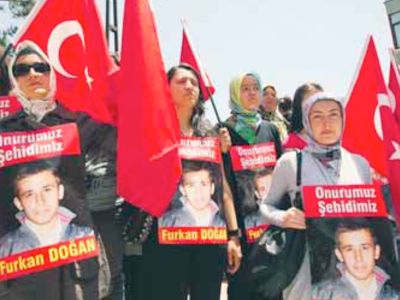

 In These New Times