In These New Times

A new paradigm for a post-imperial world

Archive for the ‘Battle for Europe’ Category

How the EU Can Emerge from the Ashes

Posted by seumasach on November 18, 2011


Spiegel

18th November, 2011

The old European Union didn’t work, that much has been made clear by the ongoing debt crisis. But many in Europe think there is now a clear path to a new, more integrated — and smaller — bloc. What must happen first? Greater democracy and less nation-state sovereignty. By SPIEGEL Staff

Read article

Posted in Battle for Europe | Tagged: | Leave a Comment »

Moscow’s high stakes energy geopolitics

Posted by seumasach on November 16, 2011

F.William Engdahl

Voltairenet

15th November, 2011

Through the new North Stream and South Stream pipeline systems, Russia is clearly redrawing the energy map of Europe. Its status as the pre-eminent supplier of natural gas-hungry European countries, including major NATO member states, is certain to significantly transform future east-west relations. As expounded by this author, energy is the lever for Russia’s return to the world stage and for checkmating Washington’s NATO encirclement strategy.

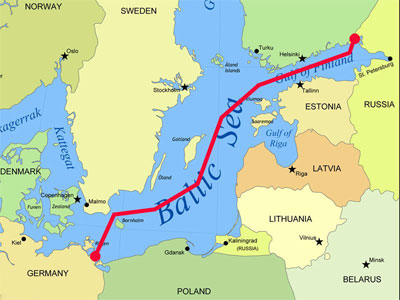
On November 7 the first of two pipelines for Nord Stream, the huge Russian-German gas pipeline project, began delivery of gas. The event was no minor affair. German Chancellor Merkel and Russian President Medvedev along with the prime ministers of France and the Netherlands and the EU Energy Commissioner formally opened the first of two 1224-kilometre pipelines at Lubmin in northern Germany, beginning delivery of the first gas direct from Russia’s Yuzhno-Russkoye gas field in Siberia to Germany.

Nord Stream was not cheap. It cost a total of more than $12 billion for the complex 760 mile long undersea pipeline through the Baltic Sea from Vyborg near Russia’s St Petersburg to north eastern Germany. It was laid in remarkable time and with extraordinary environmental precautions to insure protection of sea life, a precondition set by several EU Baltic countries. When the second pipeline is finished in late 2012, Nord Stream will be able to deliver 55 billion cubic meters of Russian gas a year, almost ten percent the entire EU annual gas consumption, or roughly one third the entire current gas consumption of China.

Nord Stream estimates it will provide enough energy to fuel 56 million West European households. With current EU political decisions over reducing CO² “carbon footprint” emissions, the Russian gas giant argues its natural gas gives 50% less CO² than rival coal plants at as much as 50% greater energy efficiency.

Even if Moscow is being more than somewhat opportunist and is not convinced about the shoddy science of global warming, Gazprom does not hesitate to use this as a shrewd political selling point. The EU is going for natural gas energy big time and Moscow intends to be a major, if not the major beneficiary of that push. In addition to delivering Siberian gas to Germany, Nord Stream will deliver to the United Kingdom, Denmark, the Netherlands, Belgium, France and the Czech Republic.

Moscow appears to hold a winning hand in the one important non-military lever it has to tip the global geopolitical balance of power in its direction and away from Washington’s overwhelming dominance. Oil and natural gas are at the heart of the strategy. For some months Russian production of crude oil has surpassed Saudi Arabia’s to be the world’s largest oil producer with over 10.3 million barrels daily, nearly one million barrels more. [1] And in terms of known reserves of natural gas Russia is far away the world leader according to industry data.

Russian natural gas has increasingly been the foundation for a brilliant series of Russian energy geopolitical initiatives for several years. Gazprom, a closely-held state company, is the centerpiece of this energy strategy.

To counter the eastward march of NATO into countries of the former Warsaw Pact such as Poland, the Czech Republic or Romania and the various US attempts to lure Ukraine and Georgia into NATO, Russia’s Vladimir Putin, both as President and more recently as Prime Minister, has used the economic lever of Gazprom. With its enormous gas resources Russia seeks to win stronger economic ties in western Europe, thereby hopefully neutralizing somewhat the potential military strategic threat from the NATO encirclement. No country has been more the focus of this Russian pipeline diplomacy than former wartime foe Germany where Nord Stream lands.

JPEG - 32.4 kb
North Stream map

The undersea route across the Baltic to Germany was chosen by a German-Russian consortium including Gazprom with 51% and the German chemicals group BASF Wintershall and E.ON Ruhrgas of Germany each today with 15.5% share, giving the German-Russian partners a dominating 82% control. Further adding to the political support from key EU countries, later they were joined by N.V. Nederlandse Gasunie and France’s GDF Suez which each own a 9% share.

The Baltic undersea route was chosen deliberately to avoid potential geopolitical disruptions such as occurred several years ago when a pro-NATO Ukrainian government blocked Russian gas deliveries to Western Europe to undercut Russian attempts to come closer to western Europe. Behind Ukraine was the long arm of Washington. [2]

Had Ukraine joined NATO as Washington urgently sought after Kiev’s 2004 “Orange Revolution” brought Washington’s man Viktor Yushchenko in as President, then Ukraine would have been in a strategic position to economically strangle Russia on command. Prior to opening of Nord Stream in November some 80% of all Russian gas exports to EU countries—mainly to Germany, Italy and France—were flowing across Ukrainian territory. Political instability and ongoing NATO meddling in Ukraine dictated the decision to build the new Nord Stream undersea route to Germany and other EU markets bypassing entirely Ukraine and Poland. Today some 40% of all state revenue in Russia comes from Russia’s oil and gas exports. [3]

GIF - 57.4 kb

South Stream vs Nabucco

While few outside the energy industry and special political interest groups have paid much attention to it, at the same time Nord Stream was coming into play a ferocious geopolitical battle has also been raging over a second planned major Gazprom Russian gas pipeline project to EU countries called South Stream. South Stream gas pipeline will be laid on the Black Sea floor, pass through Bulgaria, Serbia, Hungary and Slovakia and on to west European markets from the southern part of the EU.

To politically counter the growing Russian energy ties to the EU, with strong Washington backing, the EU Commission proposed an alternative in 2002 called the Nabucco pipeline, curiously named after the Verdi opera. To date Turkey, Romania, Bulgaria, Hungary and Austria have agreed “in principle” to build the 3,900 km Nabucco pipeline that theoretically would pump up to 31 billion cubic meters of gas annually from the Caspian and the Middle East across Turkey into western Europe. Nabucco partners to date include energy companies RWE of Germany; OMV of Austria; MOL of Hungary; Botas of Turkey; Bulgaria Energy Holding of Bulgaria; and Transgaz of Romania.

The problem is that the Nabucco partners have yet to secure gas anywhere to fill the pipeline. Moscow has deftly locked up the gas from the obvious supplier Azerbaijan, and surplus gas from former Soviet Republic Turkmenistan is also secured in deals with Gazprom, leaving only Iran as an option, something politically Washington is not ready to consider, to put it mildly.

Both Nord Stream and South Stream came into being when Ukraine’s previous Yushchenko regime, with reported strong US behind-the-scenes backing, twice disrupted transit gas flows to European markets beginning 2006. To assure stability of supplies, Moscow created both new pipeline projects to bypass Ukraine. [4]

The geopolitical problem for Washington and its allies in Brussels is the fact that its Nabucco project appears dead in the water before it even gets started. Not only has Gazprom locked up the major gas supply sources including Azerbaijan. Nabucco is also far more costly than its Russian rival.

Latest estimates put Nabucco’s ultimate construction cost at almost double that of South Stream. Tamás Fellegi, Hungarian National Development Minister, recently stated that the cost of Nabucco gas pipeline will exceed original plans by four times. “No one can predict the final cost of Nabucco, but according to optimistic estimates, its cost may reach 24-26 billion euro,” Fellegi said. [5]

JPEG - 24.4 kb
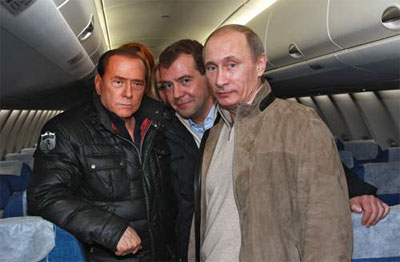
Former Italian Prime Minister Silvio Berlusconi with Russian leaders Medvedev (center) and Putin. Italy’s Eni and Russian state firm Gazprom are partners on the South Stream project.

In late October Gazprom made a major move to secure partners for its South Stream in a Moscow meeting with its largest consortium partner, Italy’s ENI. [6]

Some days before in September, Gazprom secured the significant participation into South Stream of its major Nord Stream German partner, BASF Wintershall, a major blow to Nabucco hopes. They joined the major French energy company EDF to give the South Stream project major clout versus the floundering Nabucco.

Last April, Turkey, also at least on paper a key player in Nabucco, gave permission to Gazprom to begin offshore prospecting for the potential undersea route of South Stream, a first step to gain Turkish approval to begin construction in Turkish territorial waters on the Black Sea. Turkey is trying to play a new role as an energy crossroads between the EU and its neighbors. By giving Gazprom the green light to begin prospecting, Turkey’s Erdogan government clearly has decided not to put all its energy eggs into the NATO Nabucco basket. [7]

Possible routes for Gazprom’s South Stream Pipeline

Already Gazprom is the largest natural gas supplier to the EU. Gazprom with Nord Stream and other lines plans to increase its gas supply to Europe this year by 12% to 155 billion cubic meters. It now controls 25% of the total European gas market and aims to reach 30% with completion of South Stream and other projects.

Rainer Seele, chairman of Wintershall, suggested the geopolitical thinking behind the decision to join South Stream: “In the global race against Asian countries for raw materials, South Stream, like Nord Stream, will ensure access to energy resources which are vital to our economy.” [8]

But rather than Asia, the real focus of South Stream lies to the West. The ongoing battle between Russia’s South Stream and the Washington-backed Nabucco is intensely geopolitical. The winner will hold a major advantage in the future political terrain of Europe.

According to Andrei Polischuk, an energy analyst at the BKS Finance Group, Nabucco is in far the weaker position at present. “This project is facing several problems. One of them is how to fill it with gas and how to find a resource basis. The second is its growing cost. Earlier, the project was estimated at 8 billion US dollars, but at present, it has grown up to 12 to 15 billion US dollars.” says Polischuk. “All these projects have first and foremost a hidden political motive. By implementing them, Europe tries to lower its dependence on Russian gas.” [9]

Reinhard Mitschek, director of Nabucco Gas Pipeline International, recently admitted that Nabucco now has been pushed back until 2017, three years later than originally planned. The construction work won’t begin until at least 2013. He feebly admitted in a recent press conference when pressed on a date for gas deliveries, that gas would flow, “as soon as there are firm indications that gas supply commitments are in place.” [10]

EU Nacht und Nebel Raid on Gazprom

As if on cue, just days before the planned opening ceremony for Gazprom’s Nord Stream pipeline the EU launched an unprecedented “nacht und nebel” style raid on the offices of Gazprom and its EU partners covering ten countries.

In response to a complaint by the Washington-friendly government of Lithuania, on 28 September EU officials raided Gazprom and associated offices in central and eastern European states to investigate firms involved in the supply, transmission and storage of natural gas. The Commission claimed the raids were linked to “suspicions” about anti-competitive practices.

The raids were an unprecedented use of new EU “antitrust” weapons including the threat of fines up to 10% of a company’s global turnover. Following a Thatcherite “free market” model, the EU Commission has in recent years forced E.ON, RWE and ENI to open up or sell their energy pipelines to rivals. E.ON and GDF were also forced to dismantle their market-sharing deals.

The EU is working a so-called Third Energy Package, which imposes limits on ownership of EU pipeline infrastructure by gas suppliers and calls for the “unbundling” of over-concentrated ownership. Under the rules, Russia could be forced to sell off parts of its pipeline network in the EU, something Moscow is understandably not about to do. It could open a Pandora’s box of geopolitical interference with potential for anti-Russian companies to in effect sabotage the vital and growing Russian gas trade with the EU, a mainstay today of Russian state finances.

The Gazprom raids were explicitly political. The EU even admits it has little evidence: “We’re at the beginning of the investigation; we have our suspicions and we have to see whether these are confirmed on the basis of the evidence we find and our analysis,” Commission spokeswoman Amelia Torres told press in Brussels. [11]

According to Reuters, “A Commission official, who declined to be named, told Reuters the raids were part of the EU’s efforts to wean itself off reliance on Russian gas and concerns about Gazprom’s power as a state-controlled entity.” Gazprom itself clearly links the raids to their recent progress on South Stream: “My guess is that it comes as Russia is speeding up its projects, including the South Stream underwater link,” a Gazprom source said. [12]

Vladimir Feigin, a member of the Russian delegation discussing the issue with EU officials, charges the European Commission with taking a “dangerous path” with the raids. “It’s not a simple demonstration of muscles … There are lots of issues, which are highly politicized, including Gazprom’s long-term contracts,” he insisted. [13]

While free market game rules may sound attractive to market outsiders, for the future planning of Gazprom long-term fixed contracts are essential. As oil markets reveal in recent years, while prices sometimes fall, most often they are subject to manipulation by major Wall Street banks like JP Morgan Chase, Citigroup or Goldman Sachs, the gang that pushed oil prices above $147 a barrel in June 2008 at a time supply on the world market was in glut, making a literal killing in the process. [14]

In anticipation of the larger export market for its gas to Europe, Gazprom has been making huge infrastructure investments across Europe which could be wiped out by an adverse EU decision. It is in the process of doubling its underground storage capacities for gas. It already operates gas storage facilities in Austria and leases facilities in Britain, France and Germany to handle the planned new flow from Nord Stream and South Stream. As well, Gazprom has built a joint venture storage facility with Serbia to serve gas exports to Serbia, Bosnia-Herzegovina and Hungary. Feasibility studies are being done for similar joint storage projects in the Czech Republic, France, Romania, Belgium, Britain, Slovakia, Turkey and Greece. This, in addition to the major investment in the pipelines, makes it clear the EU raids are aimed at Moscow’s energy jugular. [15]

Were Moscow to succeed in completing South Stream and retain its integral control over the delivery pipeline infrastructure, it would represent nothing less than a major geopolitical defeat for Washington. Since the collapse of the Soviet Union in the early 1990’s, Washington energy geopolitics in the Caspian region and across Eurasia into Russia have attempted to weaken if not permanently cripple the one major remaining geopolitical lever Moscow holds to counter Washington’s NATO encirclement strategy. Not letting itself be totally dependent on EU gas or oil revenues, Moscow has recently indicated it is greatly increasing its focus on building long-term energy partnerships with its eastern neighbors of Eurasia, most notably with China. The geopolitical implications for Washington of that shift will be examined in a subsequent article.


[1] News Wires, Russian Output Hits Post-Soviet Highs, 2 November 2011.

[2] “Ukraine Geopolitics and the US-NATO Military Agenda”, by F. William Engdahl, Voltaire Network, 24 March 2010.

[3] Friedbert Pflüger, “Russia and Europe: Time to bury the hatchet-and embrace the market,” 20 October, 2011, European Energy Review.

[4] RIA Novosti, “Ukraine lost reputation of reliable gas transit country – Yanukovych,” 19 October 2011.

[5] ABC.AZ, “Nabucco project cost to exceed value of South Stream and make it world’s most expensive gas pipeline,” 24 October 2011.

[6] “ENI, Gazprom CEOs discuss South Stream Development,” October 17, 2011, www.offshoreenergy.com

[7] Newswires, “Turkey gives offshore permit to Gazprom for South Stream project,” 11 April, 2011.

[8] UPI, “Wintershall joins South Stream consortium,” 16 September 2011.

[9Moscow Times, “Europe still wants to go around South Stream,” 30 September 2011.

[10] M K Bhadrakumar, “Russia redrawing Europe energy map,” Asia Times Online, 12 May 2011.

[11] Reuters, “EU raids Gazprom offices in anti-trust probe,” 29 September 2011.

[12Ibid.

[13Ibid.

[14] F. William Engdahl, “More on the real reason behind high oil prices: Part II,” Global Research, 21 May 2008.

[15] M K Bhadrakumar, op. cit.

Posted in Battle for Europe, Multipolar world | Tagged: , , , | Leave a Comment »

Eurozone Crisis: The Hidden Hand of Goldman Sachs

Posted by seumasach on November 12, 2011

I fully expect the eurozone to emerge from this crisis; however, the role of Goldman Sachs and associated politicians in germinating it is unlikely to be exposed.

IBT

11th November, 2011

Europe’s key crisis figures have all Goldman Sachs in their pedigree. Is it just a coincidence or is the financial world is trying to take over Europe?

Read the rest of this entry »

Posted in Battle for Europe | Leave a Comment »

Britain’s finest take on the Eurozone

Posted by seumasach on November 10, 2011

Posted in Battle for Europe | Leave a Comment »

Russian, German leaders launch Nord Stream gas pipeline

Posted by seumasach on November 10, 2011

RiaNovosti

10th November, 2011

Russian President Dmitry Medvedev and German Chancellor Angela Merkel launched the Nord Stream gas pipeline on Tuesday, starting delivery of Russian natural gas to Germany bypassing existing transit countries.

Read the rest of this entry »

Posted in Battle for Europe, Multipolar world | Tagged: | Leave a Comment »

From European Chaos to New World Order

Posted by seumasach on November 10, 2011

An Interview with Franck Biancheri:From European Chaos to New World Order

McAlvany Weekly


5th October, 2011

Listen to audio

-Looking ahead, national integration is the trend and likely outcome of the current European mess.
-The Breton-Woods Dollar reserve system will be replaced by a completely new monetary order between 2012-2014.
-Look for a transnational referendum to pass overwhelmingly taking Europe into a new era of transnational leadership and law.
-Be sure to visit: http://www.franck-biancheri.eu/  and   http://leap2020.eu/

Posted in Battle for Europe, Financial crisis, Multipolar world | Tagged: | Leave a Comment »

The Euro zone has just struck a terrible blow to Wall street

Posted by seumasach on November 9, 2011

Euro-Synergies

9th November, 2011

La zone euro vient de porter un coup terrible à Wall Street

Grâce aux mesures prises mercredi [26 octobre 2011], la zone euro peut se replacer en acteur crédible d’une nouvelle donne économique mondiale. Selon Franck Biancheri, du Laboratoire européen d’anticipation politique, les partenariats vont se multiplier avec les pays du BRICS. Une redistribution qui effraie l’Amérique.

Le sommet de la zone euro de mercredi a-t-il accouché d’une Europe plus forte ?

A tous points de vue. L’Union européenne a démontré qu’elle entendait gérer la Grèce sur le long terme, car il est clair qu’un pays qui n’a pas de cadastre digne de ce nom ne peut se mettre à jour en moins de cinq ou dix ans.

Amener les créanciers, les banques qui avaient acheté de la dette grecque, à payer 50% de la note était une prouesse encore impensable il y a huit mois. Depuis un demi-siècle, ce type de créances était payé rubis sur l’ongle. C’est une rupture majeure. C’est un rafraîchissement gigantesque pour l’Europe, et une bonne chose pour la perception qu’elle a d’elle-même.


L’augmentation de 440 à 1000 milliards d’euros du Fonds européen de stabilité financière (FESF) serait donc la traduction d’une bonne gouvernance ?

L’Allemagne a eu une vision saine du fonctionnement du Fonds en évitant la vision « sarko-bancaire » qui voulait le lier à la Banque centrale européenne, comme les Etats-Unis l’ont fait en 2008, en donnant mission à la Fed de renflouer leurs banques. Ce piège aurait été dangereux pour la zone euro.

Malgré la décision de recapitaliser les banques, vous prédisez la disparition de 20% d’entre elles pour 2012 ?

C’est ce que j’appelle la décimation annoncée des banques au premier semestre 2012. Il faut l’entendre au sens romain du terme, c’est-à-dire une sur dix, mais je table sur la mort de 10% à 20% des banques occidentales. Elles sont trop nombreuses, et beaucoup plus faibles qu’elles veulent bien l’avouer. Les estimations faites par les experts financiers et les gouvernements sous-estiment l’impact de la crise sur ces établissements.

UBS figure parmi les établissements menacés…

Oui, de même que la Société Générale en France, ou Bank of America, énorme, poussive, qui peut s’effondrer d’un jour à l’autre. La plupart d’entre elles s’empêtrent dans des bilans mitigés, des procès à rallonges, et n’arrivent pas à abandonner des secteurs dangereux tels que la banque d’investissement. Le démantèlement de Dexia illustre bien ce processus, avec la création d’une banque spéciale pour solder les actifs pourris et un morcellement de ses activités.

On a beaucoup parlé du sauvetage de l’euro, comme s’il pouvait disparaître. Fantaisiste?

Evidemment. L’euro ne peut pas disparaître, ni demain ni dans quelques années. Même si la Grèce avait dû revenir à la drachme, cela aurait pris deux à trois ans pour remettre en place toute l’infrastructure monétaire. Alors imaginez à l’échelle de la zone euro. Par ailleurs, je rappelle que l’euro flotte toujours à environ 1,40 par rapport au dollar, ce qui n’est pas mal pour une monnaie déclarée moribonde depuis plusieurs années. Cette mort de l’euro est un pur fantasme.

D’où vient-il ?

Des grands médias et des grands acteurs économiques anglo-saxons. Le succès de l’euro va accélérer la perte d’influence de Wall Street et de la City de Londres sur les devises. La position dominante qu’ils occupent depuis deux cents ans arrive à son terme, et c’est pourquoi ils ont déclenché une guerre de communication inouïe contre la zone euro, en s’appuyant sur la crise grecque. Une crise, rappelons-le, avivée à son commencement par la banque Goldman Sachs. Le sommet de mercredi marque un coup d’arrêt pour cette propagande qui a frôlé l’hystérie collective.

La Chine propose une aide de 100 milliards d’euros, notamment pour le Fonds de stabilité. Dangereux ?

Au contraire. Elle n’est pas la seule d’ailleurs. La Russie, le Brésil sont aussi sur les rangs pour investir en Europe. Pourquoi faudrait-il avoir peur de la Chine ? Certaines voix crient au loup, alors que personne ne s’est inquiété de l’identité européenne lorsque, durant des décennies, ce rôle était joué par les Etats-Unis. Depuis le mois d’août, la Chine a mis un frein à l’achat de bons du Trésor américain. Comme d’autres pays, elle veut sortir du piège du monopole du dollar. Une Europe crédible et un euro qui sort renforcé de cette crise lui offrent cette solution.

Assiste-t-on à un basculement des alliances économiques ?

L’axe se déplace en effet, car le monde devient multipolaire. La zone euro, qui progresse vers cet « Euroland » dont nous avons besoin, est appelée à créer de nouvelles alliances avec la Chine, et d’une manière générale avec les pays émergents du BRICS. C’est ce qui effraie Wall Street et la City : que la Chine, désireuse de se diversifier, investisse davantage dans les « eurobonds », même si ce mot est tabou, que dans les bons du Trésor américain. Dans une optique écostratégique à moyen terme, l’accord trouvé à Bruxelles mercredi est un coup terrible porté à Wall Street.

Mais la Bourse de Wall Street est montée en flèche suite au sommet ?

C’est normal : depuis quelques jours, le dollar baisse face à l’euro, et quand il baisse, Wall Street monte. Ensuite, les opérateurs financiers croyaient dur comme fer au naufrage de l’euro, ils manifestent donc leur soulagement. On le sait, les Bourses ont une capacité d’anticipation égale à zéro.

Vous parlez d’« Euroland », mais n’est-ce pas une pure vue de l’esprit ?

Plus pour longtemps. C’est inéluctable. C’est l’image de la seringue : le liquide, c’est l’Europe, et le piston, la crise, qui la pousse vers la seule issue possible. Malheureusement, elle a pris du retard car les dirigeants aux commandes se sont révélés assez médiocres, sans aucune vision politique à long terme, spécialement Nicolas Sarkozy. De fait, les rôles historiques dévolus à la France, chargée de l’impulsion, et à l’Allemagne, responsable de la mise en œuvre, se sont évanouis. L’Allemagne s’est trouvée seule pour assumer les deux tâches, alors qu’elle n’a pas l’habitude d’être le leader politique de l’Europe.

Comment cette nouvelle Europe peut-elle se construire ?

2012 sera une année de crête, un point de bascule entre deux mondes, celui d’avant et celui de demain. Il faut recourir à de nouveaux outils pour décrypter, anticiper, agir et non plus réagir dans cette dislocation géopolitique mondiale. L’an prochain, il y aura des changements de leadership dans plusieurs pays, et on vient de voir que Silvio Berlusconi a quasi signé son arrêt de mort en appelant des élections anticipées pour ce printemps. Dorénavant, deux sommets de la zone euro seront organisés chaque année, et elle va se doter d’une nouvelle Constitution en 2013 ou 2014.

Celle de 2005 avait pourtant échoué…

Ce sera un texte plus simple et plus fondamental pour quelques grands axes de la zone euro. Le précédent, trop lourd, indigeste, parlait d’une Europe passée. La prochaine Constitution sera soumise à référendum, non plus pays par pays, mais lors d’un seul vote pour l’ensemble des pays de l’UE.

Comment les Etats-Unis vont-ils sortir de leur endettement ?

Pour l’heure, ils ne peuvent pas. Dès novembre, les calculs montreront que la dette a encore augmenté. Le déficit va s’accroître, ils sont dans une spirale descendante. C’est l’effondrement d’un système transatlantique, basé sur l’alliance et le leadership de Wall Street et de la City. Nous sommes à la fin d’un cycle historique, de ceux qui se déploient sur deux, trois ou quatre siècles. Les Etats-Unis ont perdu de leur puissance et de leur crédibilité sur le plan international. Et pour leurs affaires intérieures, ils ne sont plus seuls maîtres de leur destin. Les indignés de Wall Street, comme les gens du Tea Party, sont deux symptômes de la défiance des Américains envers le système en place, où démocrates et républicains sont déconnectés des citoyens. Je pronostique l’émergence d’une troisième force politique lors des élections au Congrès en 2012.

Le Matin (Suisse), 30 octobre 2011

Posted in Battle for Europe | Leave a Comment »

First half of 2012: Decimation of the Western banks

Posted by seumasach on November 9, 2011

LEAP2020

16th October, 2011

Click on above link to view charts and diagrams

As anticipated by LEAP/E2020, the second half of 2011 is seeing the world continuing its unstoppable descent into global geopolitical dislocation characterized by the convergence of monetary, financial, economic, social, political and strategic crises. After 2010 and early 2011 which has seen the myth of a recovery and exit from the crisis shattered, it’s now uncertainty that dominates the States’ decision-making processes just like businesses and individuals, inevitably generating increasing apprehension for the future. The context singularly lends itself: social explosions, political paralysis and / or instability, return to the global recession, fear over banks, currency war, the disappearance of more than ten trillion USD in ghost-assets in three months, widespread lasting and rising unemployment…

Read the rest of this entry »

Posted in Battle for Europe, Financial crisis, UK economy | Tagged: | Leave a Comment »

Britain turns on ‘disreputable’ Germany

Posted by seumasach on November 5, 2011

Behind all the bluff and bluster, the sheer hysteria, the reality is quite simple: in order to protest the relative value of the pound the British want to see the euro devalued by quantitative easing just as the pound has been. The same applies to the dollar. They fear a resolution to the crisis which leaves the pound in freefall. Their fears are justified: that is exactly what will happen.

Britain turns on ‘disreputable’ Germany as relations sour over eurozone crisis

Guardian

5th November, 2011

Downing Street inadvertently provided a reminder last week of the depth of Britain’s ties with Germany.

In a briefing on the merits of David Cameron‘s plans to end male primogeniture in the royal line of succession, No 10 pointed out that Queen Victoria’s daughter would have succeeded her if the rules had been in place in 1901. Downing Street overlooked the fact that this would have meant that Kaiser Wilhelm II would have been our King during the First World War. Britain’s monarch would now be Princess Marie Cécile of Prussia.

Read the rest of this entry »

Posted in Battle for Europe | Tagged: | Leave a Comment »

Russia’s EU chaos campaign

Posted by seumasach on November 4, 2011

Business Spectator

4th November, 2011

Stratfor.com- Russian President Dmitri Medvedev is embarking on several trips to Europe over the next month in order to shape Russia’s position on the continent, which is undergoing a sharp redefinition during Europe’s ongoing financial crisis.

Medvedev will visit France from November 3 to November 4 for the G20 summit, during which he will hold a sideline meeting with French President Nicolas Sarkozy. Medvedev will then visit Germany on November 8 to officially launch the Nord Stream natural gas pipeline and meet with German Chancellor Angela Merkel. He plans to visit Italy and Greece later in November. Though these meetings have other purposes, they will take Medvedev to the two European heavyweight countries making the decisions about the continent’s financial crisis and the two European states feeling the effects of the crisis acutely. Such visits would not occur while these countries are mainly focused on the crisis unless Russia is also focused on the issue.

Russia’s interest in the European crisis

Moscow has been watching the crisis in Europe intently, partly for internal reasons. The Kremlin has been worried about any ripple effect the monumental crisis next door could have on Russia. Moscow already is revising its growth forecasts this year, taking into account an expected slowdown caused by shifts in Europe. High oil prices have allowed Russia to keep large amounts of cash flowing into its coffers, which will ameliorate an economic blow caused by Europe.

The Kremlin also is revising its modernisation and privatisation plans, which require tens of billions of dollars of investment from the Europeans in the next few years – much of which likely will be slashed. Moscow is also concerned that the Russian public’s perception of the European crisis will create a lack of confidence in Russia; Russian Prime Minister Vladimir Putin has assured his constituents that his return to the presidency in 2012 is intended to help lead a stronger Russia.

Although the Kremlin has been watching for effects from the European crisis to move through Russia, the crisis also has given Moscow an opportunity to take advantage of a weak and chaotic Europe.

Russia’s Europe strategy

For the past few years, the Kremlin has made several moves meant to keep the Europeans from acting as a unified entity against Russian interests. Referred to as the ‘chaos campaign’, these initiatives have fractured the Europeans’ view of Russia – Central European countries and the heavyweight countries in Western Europe have differing opinions on whether or not Russia poses a threat. These disagreements already have affected institutions like NATO, and Russia is now trying to create a similar effect by using the financial crisis as its platform.

Russia’s strategy has four steps, some of which are connected and overlap. Moscow traditionally has found this kind of complex and confusing scheme to be effective.

The first part of Moscow’s plan is to portray Russia as a beacon of stability amid Europe’s weakness. This is more of a perception campaign than anything else. Moscow wants to show Europe that during this crisis, Russia is a strong economic power. Though Russia actually is not very economically sound, it is still powerful and stable and has a lot of cash on hand. For some Europeans, such as the Germans, this will come as welcome news, as Russia will be considered a possible partner to help solve the crisis. For other Europeans, particularly the Central Europeans, this will be worrying. The Central Europeans consider the European Union’s unity to be one of the strongest limiters to a resurgent Russia, and if this unity is muddled or broken then Russia poses an even greater threat.

The second part of Russia’s plan is to purchase assets in Europe while they are cheap. Moscow already has started buying up firms throughout Europe that have been suffering during the crisis. The Kremlin is focused mainly on banks and energy firms, followed by strategic assets like ports and airports. Though most of the deals are still in the consideration and negotiation stages, the Kremlin is thinking in the long term about these assets’ uses. It also is not looking at assets that would give Russia the greatest financial return; it is considering those that would give Russia important leverage in Europe, particularly in Central Europe.

Posted in Battle for Europe | Tagged: , | Leave a Comment »

China is a friend indeed for debt-ridden Europe

Posted by seumasach on October 30, 2011

The finest minds in Christendom continue to grapple with the question which baffles them all: if the euro is so weak why is it so strong? One reason is that, speculative attacks aside, the economic fundamentals of the Eurozone are stronger than those of the anglosphere. Another is that China and other emerging economies have a clear interest in supporting the Euro as an alternative to the dollar. Thus Europe benefits from the fact that, although similar regional integration projects are in formation elsewhere, only Europe has got as far as a common currency making it the only show in town outside the dollar.

XINHUA

30th October, 2011

BEIJING, Oct. 30 (Xinhua) — With the European Union (EU) grappling with its worst financial crisis since the eurozone was set up, China has unequivocally conveyed its readiness to enhance cooperation with the debt-ridden bloc in a “win-win” manner.

Read the rest of this entry »

Posted in Battle for Europe, Currency Wars, Multipolar world | Tagged: , | Leave a Comment »